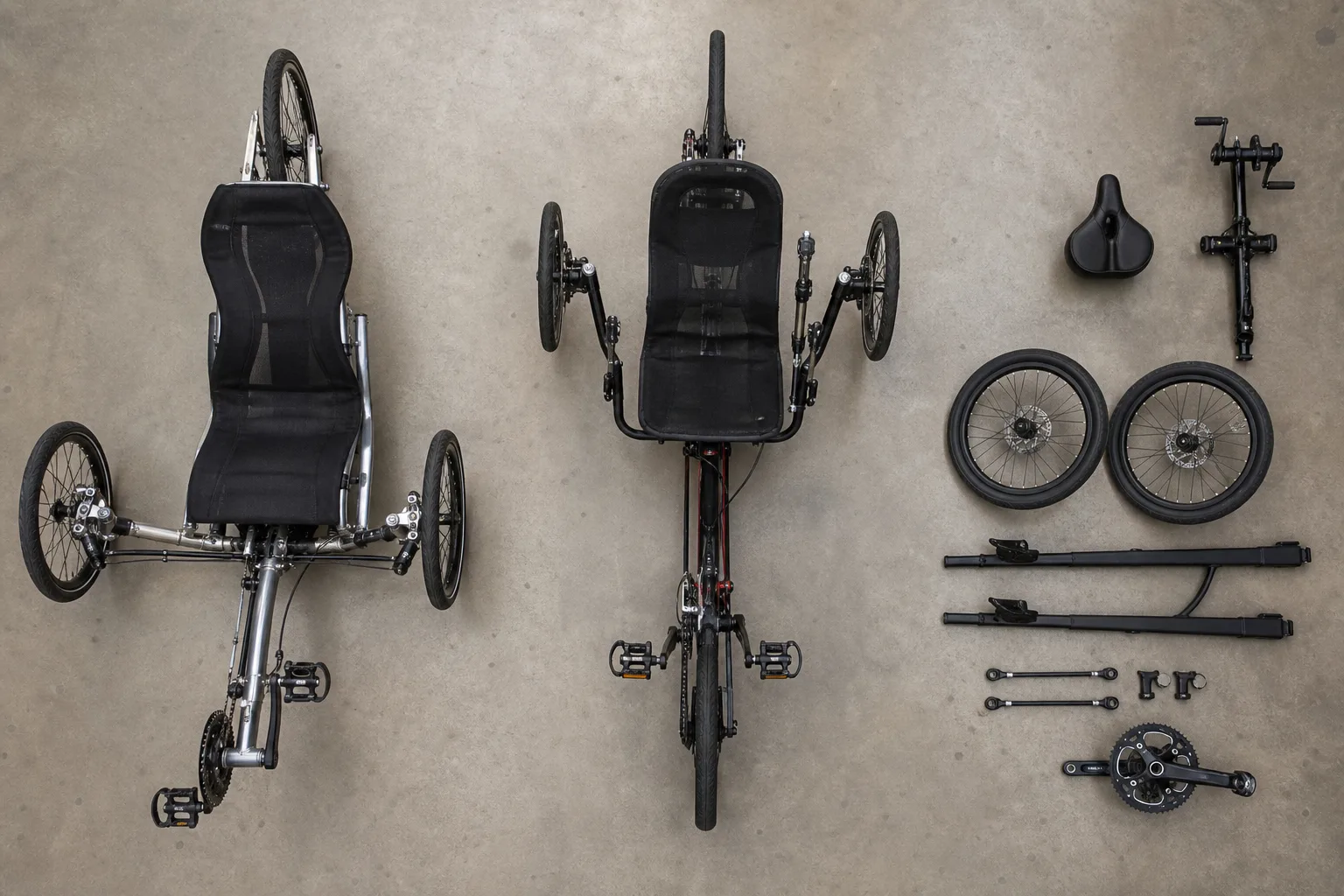
A three-wheeled cycle does not fall over when you stop, and that single fact is why most people start looking at one. What follows from it is less obvious. Because the machine holds itself up, it also resists your attempts to lean it, and a corner taken at any speed becomes a negotiation between your weight, the track width, and where the third wheel sits. Two layouts dominate the adult market. A delta carries one wheel at the front and two at the back. A tadpole reverses that, with two wheels forward and one trailing behind.
What the layout does once you turn the bars
In a turn, the machine wants to tip toward the outside of the corner, and the wheels that resist that tipping are the ones on the outside of the curve. A tadpole puts two of them out front, ahead of your center of mass, which is why a tadpole feels planted going into a bend and gives you clear warning as the inside front wheel starts to unweight. A delta has only one wheel ahead of you and the pair behind, so the same corner loads a single rear wheel and the sensation arrives later, closer to the point at which the trike would actually lift. Both are manageable. They simply ask for different habits.
The practical difference shows up in how you carry speed. On a tadpole you learn to shift your shoulders and hips into the corner, effectively leaning the rider rather than the frame, and the machine rewards it with more grip and a tighter line. On a delta you learn to scrub speed before the turn and steer through it in a steadier arc, because leaning your body on a high seat moves your mass a long way sideways relative to the wheels. Neither approach is wrong. The mistake is bringing tadpole reflexes to a delta.
Seat height, and the moment you want to put a foot down
Seat height is the second variable, and it is more consequential than the brochure figures suggest. Most deltas sit high, with the rider's hips near the height of a kitchen chair or above, which means the eye line clears parked cars, the mounting motion resembles sitting down, and a foot reaches the ground and the curb without ceremony. Most tadpoles sit low, sometimes only a hand's width above the pavement, which lowers the center of mass and makes the cornering advantage real, but the same geometry puts your feet forward rather than under you. Getting in and out becomes a controlled lower and a push up.
Decide this question before you decide anything else, because it is the one that governs daily use. If you expect to stop at a store, step off onto a sidewalk, and step back on again, the high seat earns its keep every trip. If you expect longer rides on open road with few stops, and your knees and shoulders handle the lower entry, the low seat gives you stability you will feel in every bend. Bicycle safety requirements in the United States fall under the Consumer Product Safety Commission, though seat height and layout are fit questions, not compliance ones.
Camber, and the pull you feel on a crowned road
Most American streets are crowned, higher at the centerline and sloping to the gutter so water drains. On two wheels you never notice. On three you do, because the frame stays level to its own axles while the road tilts underneath, and the trike drifts steadily toward the low side, requiring a constant light correction at the bars. A wider track feels this more than a narrow one. Steering geometry matters too, and a well-set-up tadpole with proper alignment tends to track straighter on camber than a poorly aligned one, which is worth checking on any used machine before you buy.
The short test ride that answers it
Ask for twenty minutes and a route that includes three things: a residential street with a pronounced crown, a normal curb, and a parking lot with room for a slow, tight circle. Ride the crowned street with one hand off the bars for a few seconds and notice how hard the machine pulls toward the gutter. Stop alongside the curb, put a foot on it, and see whether you can hold yourself there comfortably. Then make the tightest circle you can in both directions, slowly increasing speed until you feel one wheel go light, and note whether that warning arrived early enough for you.
Do those three things on both layouts, on the same afternoon if you can arrange it, and the answer usually settles itself without much deliberation. What you are testing is not which design is better engineered but which set of habits you would rather build, and that is a genuinely personal result.